
SIGN UP
FOR ROUTE 66 UPDATES, NEWS AND EVENTS BY EMAIL
Visit Albuquerque prohibits users from downloading images from our website.
Please use our media library for downloadable images and usage rights.
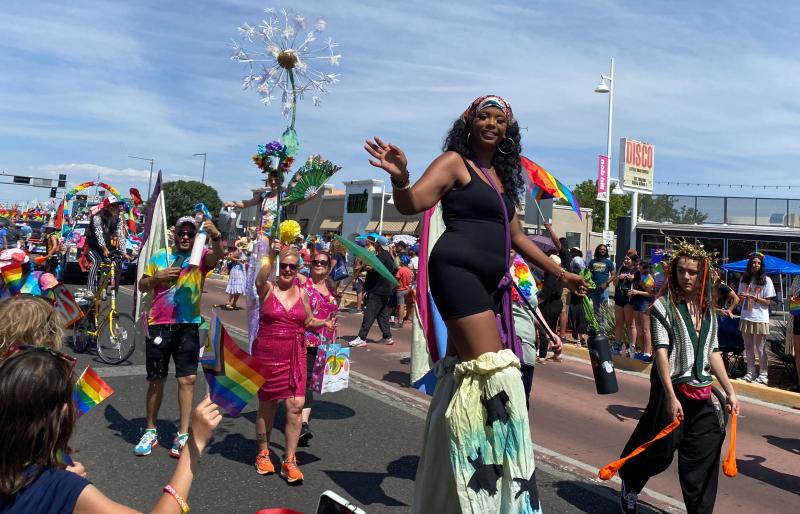
If you walk down the Mother Road in Albuquerque’s neon-lit Nob Hill, you may notice an intersection with rainbow crosswalks at Morningside Drive and Central Avenue (Route 66). The asphalt was painted in vivid hues in 2019 for Albuquerque Pride, an annual celebration honoring the resilience of LGBTQ+ people nationwide.
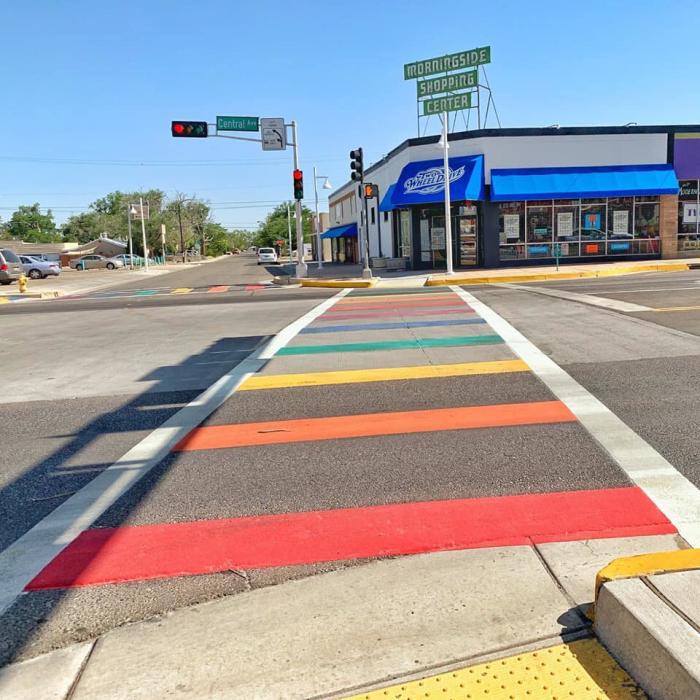
The crosswalks at Morningside Drive and Central Avenue (Route 66) in Nob Hill.
Albuquerque Pride began in 1976 with a group of 25 brave UNM students, an LGBTQ+ organization called “Juniper,” (est. 1974) who walked from Morningside Park to Morningside and Central to little fanfare — a truly radical act for the time, when being “out” posed many risks. In 1977, Pride’s second year, a crowd of over 100 people joined the march. Today, you can find two commemorative sculptures at Morningside Park in honor of the activists who paved the way for a more inclusive Albuquerque. When the memorial was erected, it was the second of its kind in the nation, behind New York City’s Stonewall memorial. Today, Albuquerque’s Pride memorial is one of three of its kind in the United States. The man behind it — Dr. P.J. Sedillo — attributes it as an example of the local community’s resilience and role in the national struggle for LGBTQ+ rights.
“My first Pride was at Yale Park, by the UNM Bookstore. I had just graduated in 1989. I was hiding behind the building because I didn’t want anyone to find out. I was out to my mom and brother, but not to my dad yet. I went home that day and started crying. I was ashamed that I was hiding,” Dr. Sedillo illustrated, “I had a metamorphosis that day.”
The next day, Dr. Sedillo went to the local gay and lesbian group that organized the Pride events. Within the following year, he would become president of that organization, serving his community in that role for 21 years. In 1997, Dr. Sedillo rallied to register Pride as a 501(c)3 non-profit, in response to a wave of hate in the country that threatened the event’s continuity and its growing popularity locally. Albuquerque Pride is still a registered non-profit today.
Though Dr. Sedillo has retired from the core Albuquerque Pride held on Central Avenue (Route 66), he helps organize an annual Pride event in Los Ranchos de Albuquerque. He continues to document Albuquerque’s LGBTQ+ history in books, such as his recent publication If These T-Shirts Could Talk: 50 Years of GLBTQ+ Pride in Albuquerque (1976-2026).
The Albuquerque Pride parade historically takes place along Central Avenue (Route 66). A cluster of gay bars sprouted up along Route 66 in Nob Hill throughout the ’60s, as people moved away from the city core to the suburbs of Albuquerque. It was prime real estate for LGBTQ+ entrepreneurs.
In the 1950s, Albuquerque’s underground gay bar scene emerged, bringing together LGBTQ+ individuals from all walks of life. A concentration of bars existed right on Route 66, in the Nob Hill neighborhood, but the community was scattered throughout the city. Specifically lesbian bars like Renee’s in the North Valley and Cricket’s in the Northeast Heights were centers of the lesbian community. Haunts like the Wellington, Foxes, the Albuquerque Mining Company and more offered space for the community to connect and thrive.
Today, you can visit the Albuquerque Social Club, which is one of the oldest continuously-operating LGBTQ+ bars and lounges in New Mexico. It was recently named one of the best gay bars on Route 66 by AFAR. In the early 1970s, the club opened in a former laundromat (and later restaurant) in Nob Hill, then called “The Heights.” By 1983, The Heights changed its name to “Albuquerque Social Club,” and would become a community cornerstone for LGBTQ+ locals to be “out” and supported in a safe space. Participants in the Pride march would gather at the Social Club, eat donuts, and walk over to UNM’s Yale Park along the sidewalks before Albuquerque Pride was a sanctioned rally.
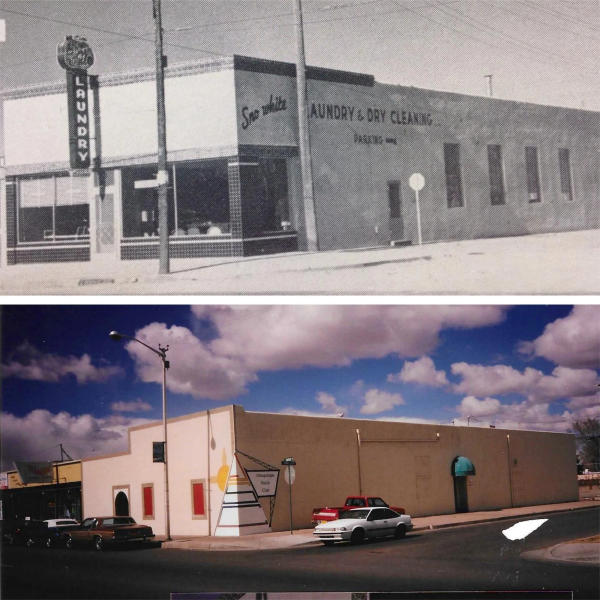
Albuquerque Social Club over the years. Photo courtesy of the Albuquerque Social Club.
The Social Club, or “SOCH” as it is known locally, continues to be a safe space for Albuquerque’s LGBTQ+ community. As a private members club (guests are welcome with a member or for an extra fee), the Social Club operates as an extension of its members’ homes, says Marshall Martinez, vice president of the Social Club and executive director of Equality New Mexico. Martinez began his membership at SOCH in 2005, and shortly thereafter experimented with a classic form of gay entertainment: drag. Martinez and a cohort of drag performers banded together to save the Social Club in the late 2000s. With a complete interior renovation constructed by the members, the Social Club entered its renaissance.
Martinez is a native of southern New Mexico, but he found a home in the Social Club. People from all over the country wander in — some on short trips, others looking to relocate for a better life. He believes Albuquerque’s LGBTQ+ community is among the most hospitable in the country.
“You walk into the Social Club from out of town, and you don’t feel like a tourist,” he says, “You are welcomed and you belong.”
New Mexico was a haven for LGBTQ+ people throughout the 20th-century – with the artist colonies of Taos and Santa Fe attracting a large number of gay and lesbian artists from out of state. LGBTQ+ historian Dr. Jordan Biro Walters’ dissertation Uncommon Knowledge: A History of Queer New Mexico, 1920-1980s, weaves together the distinct stories of gay men and women. After World War II, more LGBTQ+ people from rural areas congregated in urban centers like Albuquerque. She found that on early Route 66, hotels like the elegant Alvarado Hotel, the Franciscan and the Hilton Hotel (today, Hotel Andaluz) – both situated in Downtown Albuquerque – were tolerant of openly gay patrons. Today, revitalized hotels like ARRIVE Albuquerque and Hotel Zazz establish themselves as overnight destinations proud to host LGBTQ+ travellers to the Mother Road, where visitors can stay authentically.
After World War II, the nuclear family model was positioned as the norm, which made many LGBTQ+ people keep their identities discreet to protect their livelihoods. It wasn’t until June 27, 1969, when a nationwide civil rights movement for LGBTQ+ people kicked off at the Stonewall Inn in New York City. The gay liberation movement spawned from this resistance emphasized “coming out,” demanding equality and recognition in cities across the U.S. In the fall of 1970, the first gay activists at Albuquerque’s University of New Mexico formed the first LGBTQ+ organization on campus, aiding in the statewide fight against discrimination.
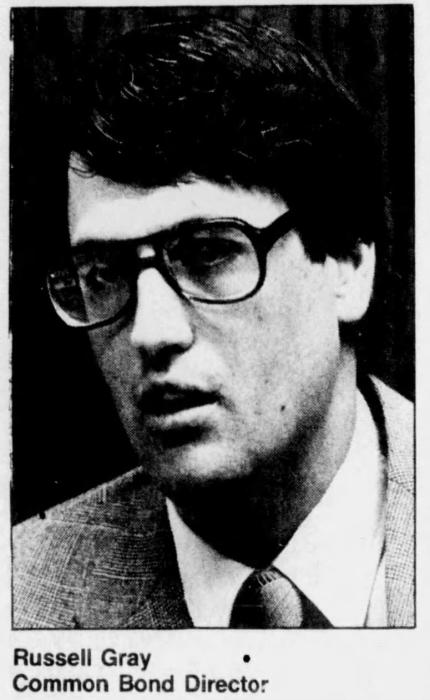
Portrait of Russell Gray as director of gay and lesbian organization, Common Bond, for the Albuquerque Journal, Sun, Jun. 2, 1985.
One public servant, Russell Gray, was known as “Albuquerque’s Harvey Milk” for his outstanding commitment to the advancement of LGBTQ+ rights in New Mexico. A Las Cruces native, Gray went to UNM Law and settled in Albuquerque for the rest of his life, advocating for LGBTQ+ community in media and grassroots organizations. While never holding public office, Gray was respected among his peers. Gray tragically passed in 1988, taken by AIDS. His impact locally and statewide continues to be honored in Pride celebrations today.
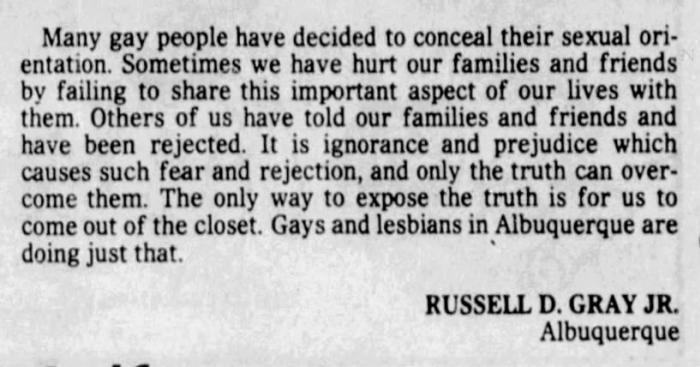
Russell Gray quoted in the Albuquerque Tribune, Wed, Jul. 14, 1982.
For the lesbian community, the University of New Mexico (UNM) on Route 66 was the epicenter for lesbian life in the 1970s. A significant number of lesbians identified with the women’s liberation movement of the late 1960s, and united with straight women to form the university’s first Women Studies program (WMST). At the time of its opening in 1972, UNM’s Women’s Studies was one of 46 university programs nationwide. The UNM Women's Resource Center and WMST were a haven for the lesbian community, providing a stage for discourses that affected them in the grand scheme of LGBTQ+ civil rights. Albuquerque’s lesbian community was always at the forefront of stewarding New Mexican culture and organizing community— without the efforts of lesbian activists, the groundwork for Nob Hill’s “gayborhood” wouldn’t have been so robust. The Gay Co-Op located on 106 Girard Blvd SE (a short distance from Route 66 and UNM) was a community center founded by lesbians and gay men. They provided vital services for LGBTQ+ people, including counseling and a telephone help line to actively support the well-being of their chosen families.
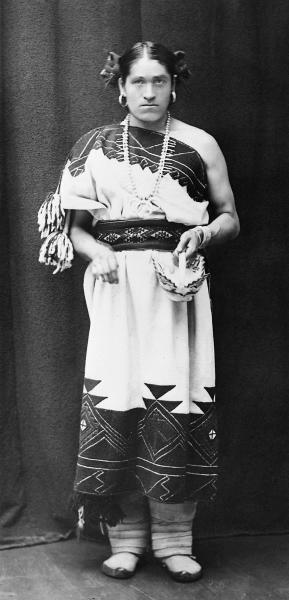
Portrait of the Late We'Wha (Zuni Pueblo [A:shiwi]) in traditional dress, c. 1871-1896. Record Group 106: Records of the Smithsonian Institution, 1871–1952. College Park, MD: National Archives at College Park.
People who may be thought of as “transgender” today have existed in New Mexico — and North America broadly — for centuries. One remarkable individual, the late We’wha* (1849-1896), was a Łamana (or, lhamana) of Zuni Pueblo [A:shiwi], a couple hundred miles south of Route 66 near Gallup. The late We’wha was a gender-nonconforming person who presented femininely and was described with female pronouns — today, she might be considered “two-spirit” (a contemporary Native American term for transgender or gender-nonconforming identity, broadly). Łamana is a Zuni word referring to a biologically male individual who lived socially, culturally and ceremonially as a woman; this was a socially-recognized “third gender” in Zuni, using both masculine and feminine pronouns historically. Many Native communities across the United States have similar roles in their respective cultures.
The late We’wha was a leader and ambassador of Zuni culture in her time. She played a major role in the preservation of traditional textile and pottery methods. She represented Zuni on national tribal delegations and gave her pottery to Matilda Coxe Stevenson, her close friend and nationally-renowned anthropologist (who was also the first woman anthropologist in the United States). The late We’wha’s legacy lives on in Zuni Pueblo and statewide education efforts, with an award created in her name by the Santa Fe Human Rights Alliance for individuals who make significant contributions to the advancement of LGBTQ people in New Mexico.
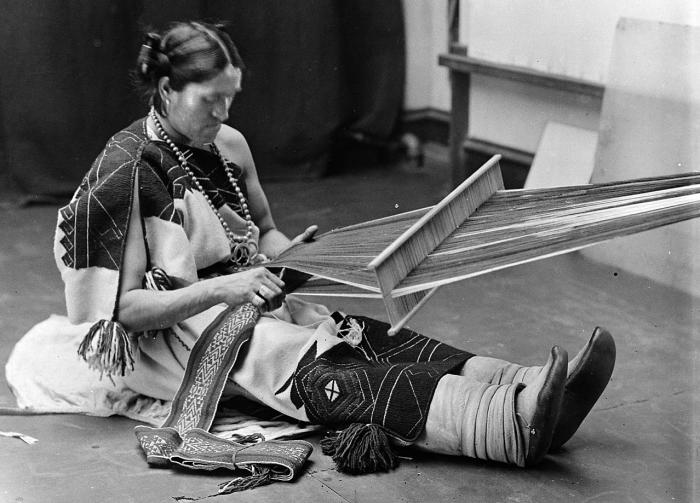
John K. Hillers, We’wha, a Zuni Lhamana, Weaving, c. 1886. Record Group 106: Records of the Smithsonian Institution, 1871–1952. College Park, MD: National Archives at College Park.
*Zuni customs discourage referring to community members who have passed on in the present tense.
Looking for ways to celebrate in community? Here are some local events happening throughout June 2026, when Albuquerque Pride’s Golden Anniversary meets the Route 66 Centennial.
Don't see your event? Check our Pride Events Calendar for more, and submit yours today!
Friday, June 5 | 5 p.m.
Wolf ‘N’ Swallow, 414 Central Ave. S.E. - Reserve your tickets here.
Saturday, June 6 | 10 a.m. - 2 p.m.
Haynes Park, 2006 Rio Grande Blvd. S.E., Rio Rancho, NM
Sunday, June 7 | 11 a.m. - 4 p.m.
Hartnett Park, 6718 Rio Grande Blvd. N.W.
Sunday, June 7 | 12 p.m. - 4 p.m.
Albuquerque Social Club, 4021 Central Ave. N.E. - Reserve your tickets here.
Sunday, June 7 | 8:30 a.m. - 10 a.m.
National Hispanic Cultural Center, 1701 4th St. S.W.
Saturday, June 13 | 1:30 p.m. - 8:30 p.m.
Nob Hill & Civic Plaza
Saturday, June 13 | 10 a.m. to 8 p.m.
Old Town Plaza
Saturday, June 13 | 11 a.m. - 2 p.m.
Morningside Park, 3901 Lead Ave. S.E.
Saturday, June 13 | 8 p.m - 12 a.m.
Old Town Plaza
Friday, June 14 | 10 a.m. - 2 p.m.
Rail Yards Market, 777 1st St. N.W.
Friday, June 19 | 5:30 p.m. - 6:30 p.m.
Civic Plaza
Friday, June 19 | 8 p.m. - 1 a.m.
Sister Bar, 407 Central Ave. N.W.
Friday, June 19 and Sunday, June 21 | 7:30 p.m.
Hiland Theater, 4800 Central Ave. S.E. - Reserve your tickets here.
Saturday, June 27 | 1 p.m. - 6 p.m.
Tiny Grocer ABQ, 1919 Old Town Rd N.W. Ste. 5
Saturday, June 27 | 1:30 p.m. - 10 p.m.
Peace Love Space, 10410 Comanche Rd. N.E.
Saturday, June 27 | 6 - 9 p.m.
ABQ BioPark Botanic Garden, 2601 Central Ave. N.W.
Recurring weekends, Fri. - Sun. | May 29 - June 28 | 10 a.m. - 4 p.m.
Snapdragon Tea, 115 Harvard Dr. S.E. Ste. 7
Recurring monthly | June 7 | 10:30 a.m. - 2 p.m.
ARRIVE Albuquerque, 717 Central Ave. N.W.