
SIGN UP
FOR ROUTE 66 UPDATES, NEWS AND EVENTS BY EMAIL
Visit Albuquerque prohibits users from downloading images from our website.
Please use our media library for downloadable images and usage rights.

By Monika Dziamka, co-editor of The Roadrunner e-newsletter.
Right around Route 66’s heyday, the term “motel” – a blend of “motor” and “hotel” – became popular. Unlike traditional hotels, motels were designed specifically for drivers. They usually featured individual rooms with doors facing a parking lot, allowing guests to park directly outside their accommodations. This convenience appealed to road trippers, often with families and luggage in tow, who were covering long distances and looking for short stays.
During the Great Depression, Route 66 became a vital corridor for migration, particularly for families heading west in search of work. For many people, motels became synonymous with affordability and accessibility. After World War II, however, the motel industry experienced a boom – and increased prosperity, the growth of the middle class, and the rise of the American road trip shifted Route 66 into a bustling artery of tourism. Motels competed with each other to offer extra benefits to travelers. Air conditioning, television, in-room refrigerators, and swimming pools became enticing amenities, signaling comfort and modernity.
Albuquerque-based anthropologist, documentary photographer and author Donatella Davanzo says Route 66 motels in Albuquerque showcased a wide variety of architectural styles and motifs reflecting trends of their time. In her new book, Route 66 Connected: Mapping the Authentic Mother Road, A Cultural and Visual Atlas through New Mexico, Davanzo shares examples of motels built in the Mission and Spanish Pueblo Revival style, Territorial Revival style, Mid-Century Modern style and more. She also points out that motel owners used eye-catching neon signs, symbols and quirky names to attract passing drivers. “La Puerta Motor Lodge [at 9710 Central Ave. SE], built in 1949, was the first motel people met driving from east to west in Albuquerque, so it was considered the door of the city. In this way, ‘la puerta’ makes sense.”
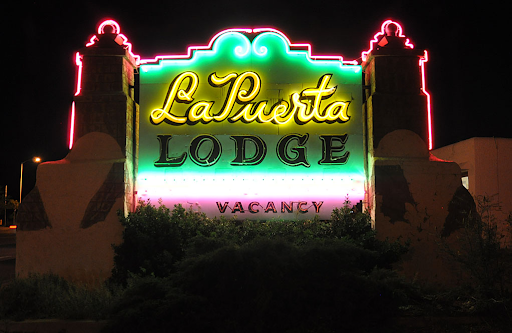
La Puerta Lodge's neon sign lit up.
Motels also reflected broader social dynamics. Interest in space exploration and technological advancements in the 1950s inspired some motel owners to decorate their properties with stars, planets and other space-related motifs. Designs related to cowboys, rodeos and Indigenous cultures upheld romanticized ideas about the Wild West. Before the Civil Rights Movement, many motel owners denied accommodations to Black travelers. In response, alternative networks and guides emerged to help marginalized travelers find safe lodging. Davanzo says three motels in Albuquerque were listed in The Negro Motorist Green Book, a guide that was published by Victor H. Green from 1936 until 1966 and listed safe places for Black travelers to visit. The only location of those three that still exists in Albuquerque is the De Anza Motor Lodge (4305 Central Ave. NE), though today it functions as an apartment complex.
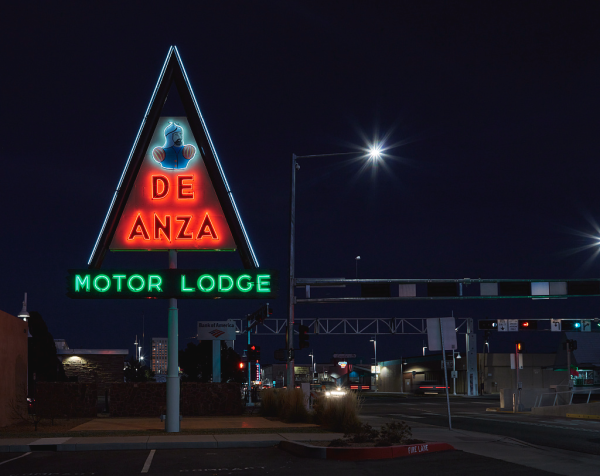
De Anza Motor Lodge neon lit up at night.
By the late 1950s and 1960s, the construction of the Interstate Highway System began to divert traffic away from Route 66. As travelers opted for faster, more direct routes, many motels saw a sharp decline in business. In recent decades, however, preservation efforts have brought renewed attention to these roadside landmarks. How they bring people together might be changing, but they still do: for example, El Vado Motel (2500 Central Ave. SW), which operated from 1937 until 2005, reopened in 2018 and maintains most of its original shape. El Vado is also home to restaurants and boutiques and hosts markets, concerts and other events.
Today, the remaining Route 66 motels in Albuquerque stand as an enduring symbol of the people who journeyed across the country in search of opportunity and adventure.
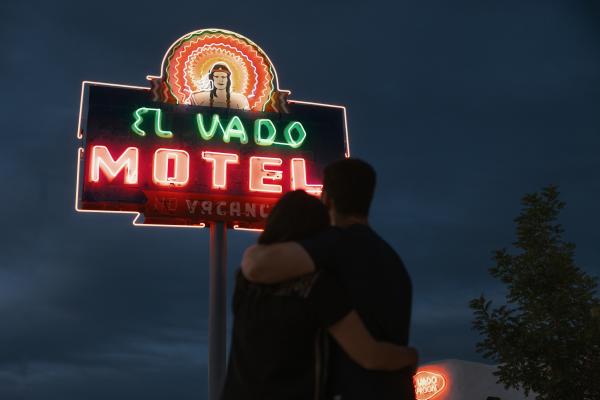
Couple hugging in front of El Vado Motel's neon sign. Photo courtesy of NMTD.