
SIGN UP
FOR ROUTE 66 UPDATES, NEWS AND EVENTS BY EMAIL
Visit Albuquerque prohibits users from downloading images from our website.
Please use our media library for downloadable images and usage rights.
Lindsey Ellen Fromm is an artist, educator, and the executive director of Friends of the Orphan Signs (FOS), a nonprofit public art organization based in Albuquerque that works to preserve and restore old signs along Route 66 and elsewhere.
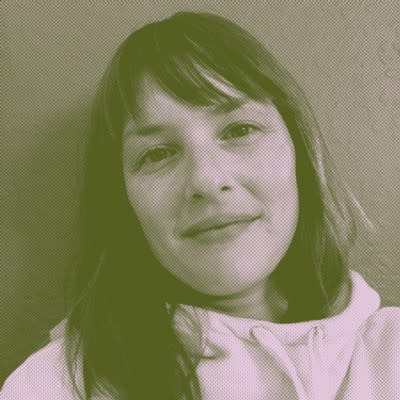
Photo courtesy of Lindsey Fromm.
As told to Monika Dziamka, co-editor of The Roadrunner.
For me, Route 66 is a thoroughfare of stories. Many stories have remained untold, in the shadow of Route 66 lore and mid-century spectacle. But a new generation of artists, culture bearers, civic leaders and community members are revealing what Route 66 has been, who was once here and is here now, and are helping us to dream what the route can be in the future. Artists with Friends of the Orphan Signs (FOS) look for these stories in community spaces, libraries, archives and sidewalks, and in the words, faces and hands of those who spend their time along Central Avenue. Using the overlooked spaces of empty or unused signs on Route 66, FOS works to elevate these stories.
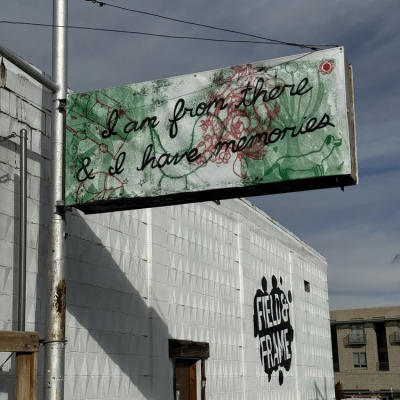
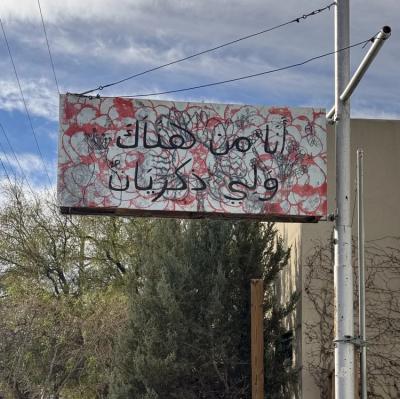
Newcomer sign [107 Tulane Drive SE], c. 2023-2024, with Albuquerque Public School students.
I’ve spent a lot of time on empty lots along Central. Some of those spaces are developed now, but I remember when they were empty and I was able to walk across them and look at the orphaned sign from a distance. The signs are called “orphans” because they don’t have a building to serve a purpose for. The Trade Winds Shopping Center is one spot I spent a lot of time at before the new center was developed. We used to put poetry up on the readerboard that we collected in a variety of ways, including from folks waiting for or getting off the 66 bus going eastbound on Central. That’s how I learned to use a sign change arm and arrange words letter by letter in space. It reminded me of when I used to set letterpress type, and it was nearly as precarious as that. People would spend time with us out there and tell us their stories as we worked, arms over our heads and squinting into the sun. Camaraderie was built around watching us struggle to put the letters up and seeing their words arranged in real time.
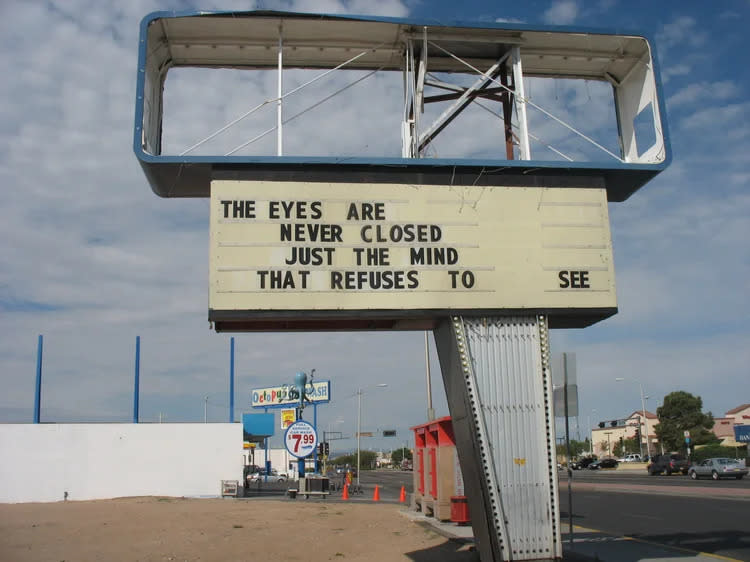
Friends of the Orphan Signs poetry on the Trade Winds Readerboard [5400 Central Ave SE, demolished], c. 2010-2014.
I rode the bus for many years, and that’s how I came to learn and love all the signs along east Central. I’ll never forget the first time I saw the Trade Winds sign and it said, “forget closed dreams wanted.” Later it was changed and said, “I clap for you in my head all the time,” which has become my life mantra. I stood up and gasped and nearly knocked my nose against the glass as the bus lurched past the sign. I knew right then I needed to be a part of whatever and whoever was writing those messages. So when I referred to “us” before, I am referring to Ellen Babcock, who founded FOS, and a group of scrappy artists from UNM who wanted to turn signs into art in the early 2010s.
For the most part, we recognize that the signs we transform won’t be accessible to us forever. This is the nature of urbanization and policy change over time, population and priority shifts. At one point the sign served a purpose, then the building was torn down for whatever reason, leaving it orphaned. Maybe the building was abandoned and has been for sale for a long time, leaving the sign to sit rusting. That’s where we step in. We connect with property owners and ask to use space on the sign temporarily, with low-impact installation of leaderboard letters or vinyl banners, then we propose a project to the community.
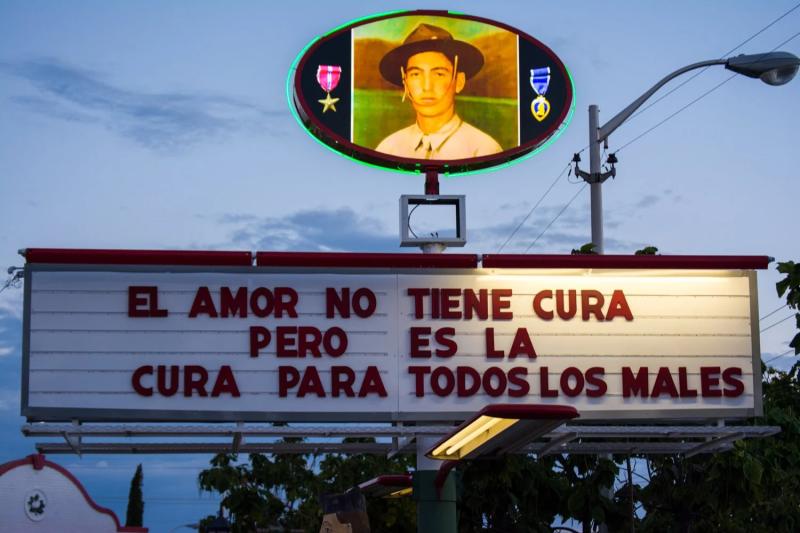
Casa Barelas sign [1024 4th Street SW, Pre-1937 Route 66], 2015.
We expect that eventually the property will change hands and the sign will be torn down or used again for advertisement, and we have seen this happen several times. In the meantime, we foster the signs we use, and the indefinite timeline becomes an asset because it keeps us motivated to change the artwork frequently and continue to collaborate with new communities. This way, the space of the sign remains accessible, and many people can be a part of what we do and see themselves represented in public space over time.
We aren’t in the business of “preserving” vintage signs, per se, though we love to help out with those initiatives — like the incredible Revamp Route 66 Sign Improvement Program in 2024! Shout out to CABQ Arts and Culture and Metropolitan Redevelopment for creating that opportunity and making sign preservation and renovation a priority.
We have had the opportunity to create “permanent” signs, though even those can be indefinite. Our first full sign renovation, the Revivir sign, was installed in Nob Hill in 2012 but removed in 2019 when the lot was redeveloped. Today you can see Revivir at the West Central Route 66 Visitor Center with fresh neon. We’d love to make more signs into permanent works of public art, but this requires investment from property owners who would like to steward works of art on their property. So, this is a call to those who own unused signs across the city: Please consider dedicating that space to community artwork!
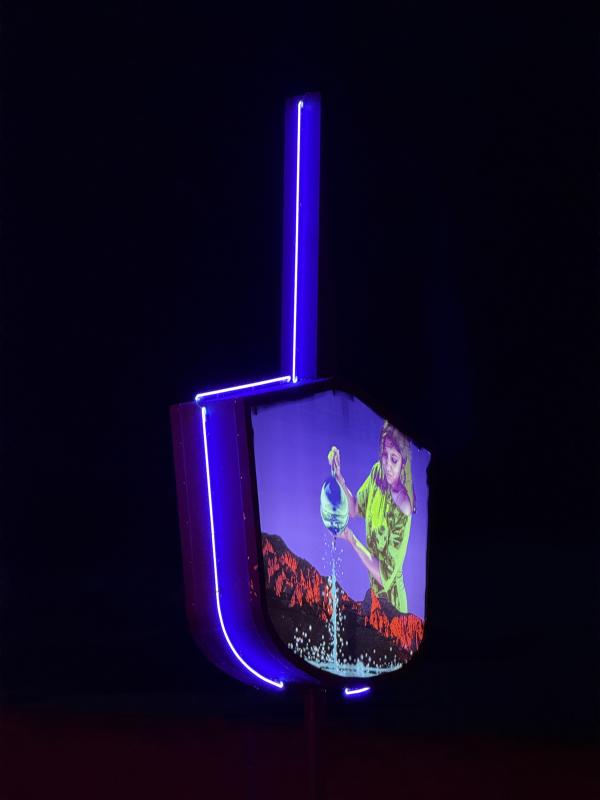
Revivir sign at the West Central Route 66 Visitor Center. This sign was formerly located at 4119 Central Ave NE.
I wish for a collaborative and representative future for Route 66, with local organizing continuing to make profound, visible impacts on the neighborhoods along the route. I can imagine a future where the signs are willingly given over to local artists to transform into artwork, rather than waiting to once again advertise something. As society inevitably transforms in the next decades, I see an opportunity for FOS to participate in new ways of engaging with the built environment.
Our organization’s dream is to create and inspire a new wave of iconic signage that the next generation will look upon as fondly as we do mid-century signs. FOS is built on the ethos of sustainability: we don’t necessarily need to build new things when there is so much that already exists and can be salvaged. By transforming a deteriorating vintage sign into a work of art, we can still save a relic of the past and create something new for the future. I hope others will join us in transforming the city’s landscape in this way.
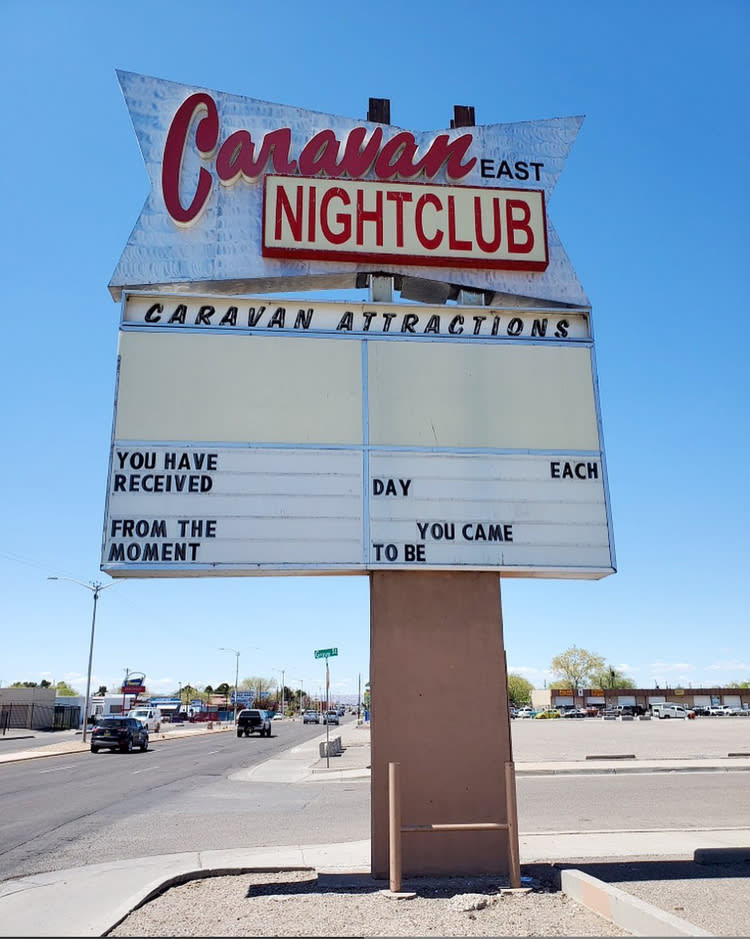
The former Caravan East Nightclub sign [7605 Central Ave NE], activated by Friends of the Orphan Signs for Keywords, c. 2019-2021.