
SIGN UP
FOR DISCOUNTS, NEWS AND EVENTS BY EMAIL
Visit Albuquerque prohibits users from downloading images from our website.
Please use our media library for downloadable images and usage rights.
In conversation with Roadrunner editor, Monika Dziamka.
“The Mother Road” signifies to me the fun and adventurous road trips I took with my family when I was younger. Whether we were headed east to Albuquerque for the State Fair or west to Gallup to visit relatives, it was the road we took from Grants, New Mexico. I recall driving through the El Malpais with the rough, black rock and the contrast of the vibrant, green plants and trees that grew out of it and seeing Mount Taylor in the distance. I remember the first time I drove on it to Gallup with my grandmother, and being so nervous about driving her car. In high school, I cruised from one end of Central Avenue [Route 66] to the other, which took an hour one way back then, and included a short side trip through San Gabriel Park by the river. In either direction, I saw the Route 66 road signs along the way.
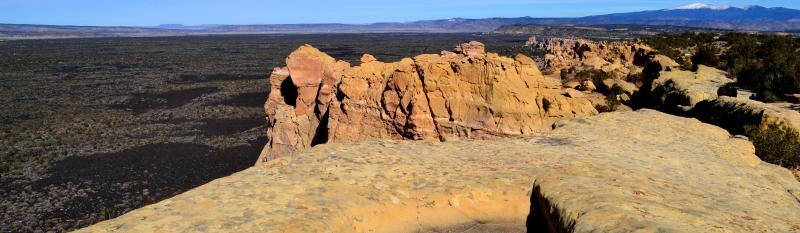
El Malpais National Monument.
Why, of course, Downtown at the corner of 5th Street and Central where the KiMo Theatre is located! In its heyday, this area was a very vibrant part of Albuquerque for residents and travelers alike. Today, it is befitting that the KiMo is located on the corner, thus allowing the building to showcase itself daily to passersby.
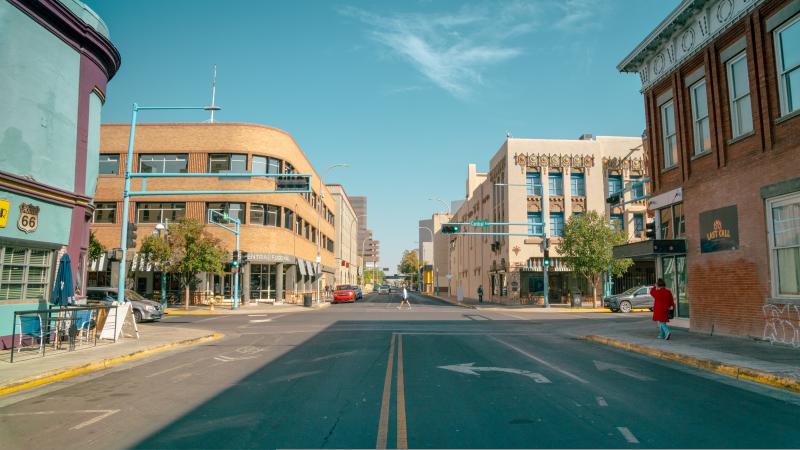
5th St. and Central Ave. Photo courtesy of Dominic Valdez.
I can remember driving on the Rio Puerco Bridge as a child and thinking it was the coolest thing ever! I looked forward to driving on it anytime we came to Albuquerque. When I pass it to this day that memory comes back to me, and it is quite unfortunate that cars can no longer drive on it.
The KiMo Theatre opened on Sept. 19, 1927, and is considered to be one of the premier examples of a short-lived architectural style known as Pueblo Deco that fused the spirit of the Southwest Native American cultures with modern Art Deco elements that were popular in the 1920s and 1930s. The vision the owner, Oreste Bachechi, along with the architect, Carl Boller of the Boller Brothers Architectural Company in Los Angeles, California, had for this iconic theater is one in a million, and brings “wows” every time a first-time visitor walks into the building. The KiMo’s murals, symbols, lighting and overall atmosphere comprise the many details that were taken into consideration when planning and designing the building. It is a true work of art! Also, I cannot leave out the story of little 7-year old Bobby Darnell, our resident ghost, who was tragically killed when a water boiler system exploded due to a gas leak. Performers and renters are asked to leave a little token in Bobby’s shrine with the belief and hope that their event will go off without a hitch. I should mention that he does visit me from time to time….
I wish that it will remain to be a historic roadway that is recognized for what it did to provide experiences to travelers and livelihoods to the residents along its path, including Albuquerque as well as the other New Mexico cities and towns it traversed through. These places not only provided food and shelter, but allowed for the creation of some of the most beautiful neon signs attracting visitors to their businesses, thus providing an Art Deco culture in and of itself. My wish is that what remains of the “Mother Road” will be around for another 100 years, and for many more generations to enjoy and learn about this iconic road and its impact.
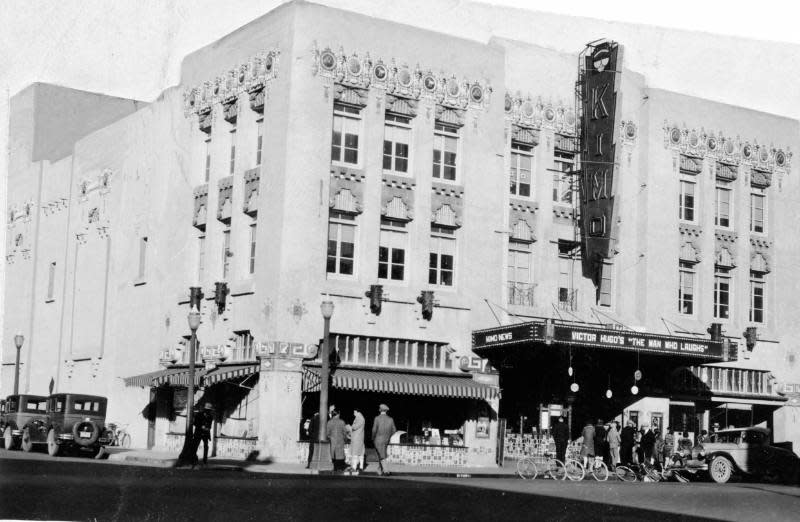
The KiMo Theatre, ca. 1927, gelatin silver print. Albuquerque Museum, gift of John Airy. PA1982.180.718.