Jesse Littlebird has always been an artist.
“I grew up in a household full of art. Both my parents were artists. As long as I can remember, it was like I didn't have any other choice.”
Jesse (Laguna/Kewa Pueblos) grew up in New Mexico, and it shows in his art. Encompassing a wide array of mediums and canvases from murals to cars, Jesse weaves a narrative across all of his pieces.
“A lot of Indigenous philosophy is within everything,” Jesse said. “I grew up surrounded by not just the Pueblo culture that’s represented here in New Mexico, but worldwide Indigenous thought and culture.”
@visitalbuquerque Have you seen this new mural in Downtown Albuquerque by Jesse Littlebird and Thomas Christopher Haag? You can learn more about this project among others, his artistic background and some of his inspirations by reading our full interview with him. The article drops Friday, September 19th. 😎
♬ Day & Night - Thundercat
Jesse has become a well-known local artist. His work in the past few years has reflected modern life in New Mexico, “as well as a little bit of a critique on Western art in general and how a Native identity fits into that.”
One of Jesse’s recent projects is a mural at Central Avenue and 7th Street on the side of the Historic El Rey Theater. It is a part of the Route 66 Remixed project, where people can explore different public art installations along Route 66 (Central Avenue) in Albuquerque in celebration of the upcoming Centennial in 2026. He collaborated with Thomas Christopher Haag on the mural, which depicts three buffalo.
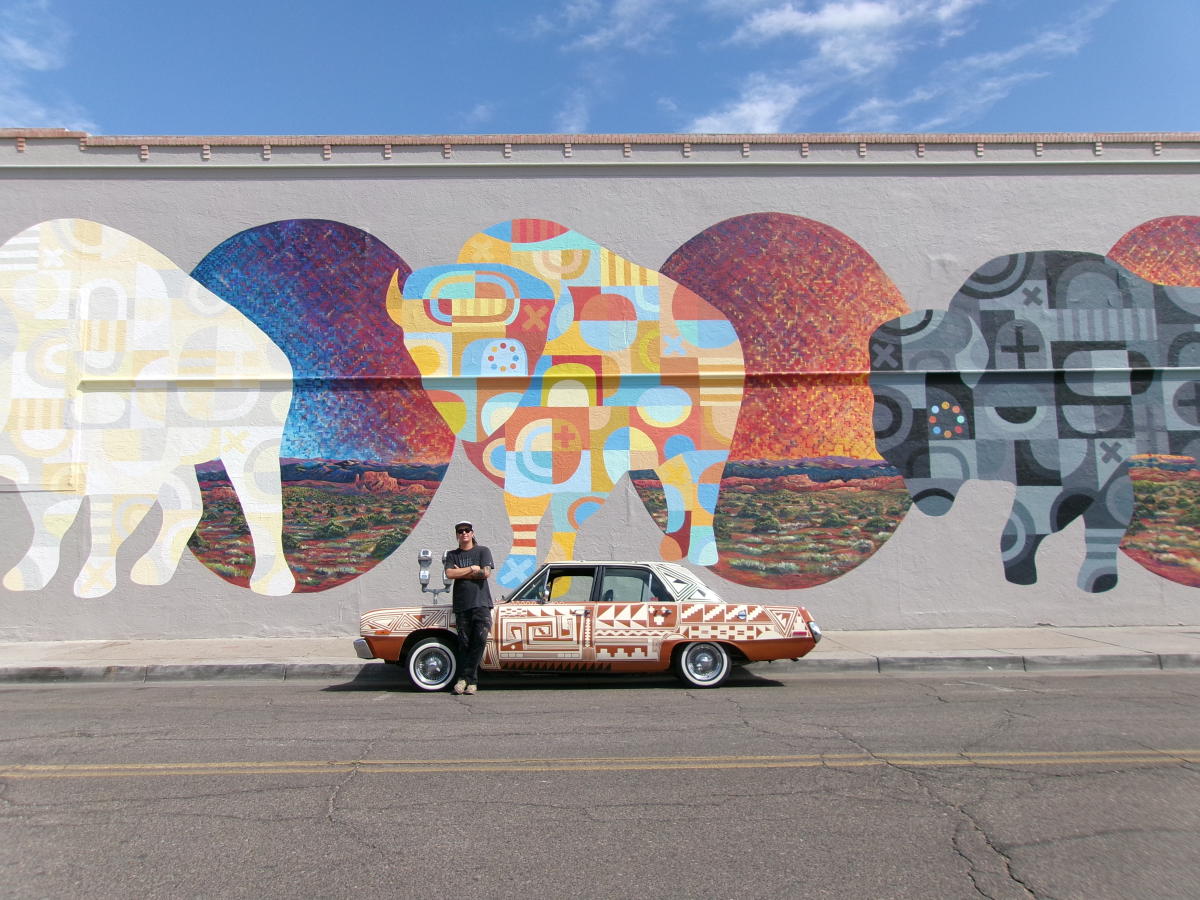 Jesse Littlebird in front of his mural and a car he painted.
“The idea that I had pitched…was what did Route 66 look like before Route 66 was here,” Jesse said. “I’m always going back to the land was here way before us, and the land will be here way after we’re all gone.”
Jesse was also inspired by the number of trade routes that passed through Albuquerque long before it was a city. Buffalo served as a major food source for Native Americans before the herds were decimated, but are now rebounding. Jesse wanted to emphasize the idea of returning, and representing the past, present and future.
Another recent project was the opening of Kukani Gallery earlier this year. Jesse collaborated with a few people, including Albuquerque artist Max Baptiste, to open the Downtown art gallery, which had been a dream for years.
“I've wanted to curate for the longest time and give a jumping off point and a pedestal to artists who are working here in the Southwest,” Jesse said. “It’s not just emerging artists but people who have been working for a long time and never really got the recognition.”
Kukani helps free artists from some of the typical expectations of the art world. Jesse funded the gallery with money from his own art sales.
“It's nice that we might sell a couple pieces out of here, and we want to get people to collect some of these artists' works, but it's also freeing to them that they don't have to be reliant upon sales,” Jesse said.
The gallery also reimagines what it means to be a part of a community. Jesse sees it as introducing communities to each other.
“Someone in Japan being exposed to New Mexican art, they have a totally different experience, versus someone who grew up here who knows what tinwork means to someone or what Native portraiture means to someone.”
Jesse wants Kukani to elevate the game and become a part of a thriving arts community in Albuquerque, where the city is taken seriously as an arts destination.
“This is my home, I'm from here. I have to build up this art market here in Albuquerque, and New Mexico as a whole, so that artists can live here, work here, continue to stay here and have a successful career here.”